






FAQ’sQ: What’s involved in learning to scuba dive?A: Learning to scuba dive is an incredible adventure! With PADI as your training organization, your path to breathing underwater is accomplished in three exciting phases: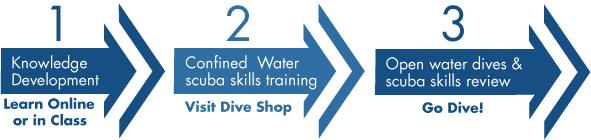 Q: What’s required to take scuba lessons?A: If you have an appetite for excitement and adventure, odds are you can become an avid PADI scuba diver. You’ll also want to keep in mind these requirements:Minimum Age:
Q: Do you need to own any gear when signing up for an open water course?A: You don’t need your own gear, we have different options you can choose from when you enroll (choose the option to include gear or exclude when you already have your own gear).When you start learning to scuba dive, as a minimum, you want your own soft gear (mask, fins, snorkel, wetsuit), because these have a personal fit. When you enroll in one of our courses you are eligible to buy a set of softgear at a very special rate (Please ask your Instructor!) Q: Do I need to be a strong swimmer to dive?A: You need to be comfortable in and around water.Q: How long does it take to finish the course?A: It’s possible to complete your confined and open water dives in as few as three or four days by completing the classroom portion as home study.The PADI Open Water Diver course is incredibly flexible and performance based, which means that your PADI Instructor can offer a wide variety of schedules, paced according to how fast you progress. Your instructor’s interest is in your learning to scuba dive, not in how long you sit in a class. So, training is based upon demonstrating that you know what you need to know and can do what you need to do. This means that you progress at your own pace - faster or slower depending upon the time you need to become a confident scuba diver who dives regularly. Generaly it takes 4 days (2 weekends) to complete a PADI open Water diver course. 1st weekend we mark the Knowledge Reviews and do pool dives. 2nd Weekend you do qualifying dives. We can also schedule your training in midweek and evening classes - depending on your time available! Q: Where will the training take place?A: We have a few pools available to do our 5 Pool dives, we will choose one that are the most suitable while keeping our participants traveling and safety in mind . The 4 qualifying dives at Komati springs, Bass lake or Miracle Waters. We can qualify at Sodwana as well, extra costs apply.Q: Why PADI?A: PADI Divers carry the most respected and sought after scuba credentials in the world. No matter where you choose to dive, your PADI scuba certification card will be recognized and accepted. In fact, on most scuba diving adventures you’ll be surrounded by other PADI Divers who made the same certification choice you did - to train with the world’s largest and most respected scuba diving training organization.With more than 133,500 PADI Professionals and more than 6,000 PADI Dive Shops and Resorts operating in more than 180 countries and territories, you will likely find a PADI Scuba Instructor who can speak your language and offer you a comfortable learning experience. To serve the needs of divers worldwide, translations of PADI materials are available in at least 26 languages. Q What hidden costs are there?A: Food, drinks and fuel.None of our courses includes accommodation. Komati springs, Bass Lake and Miracle Waters have an entrance and camping fee. If going to Mozambique there will be border taxes, Temporary import permits for vehicles (if taking your vehicle across the border). When going to Sodwana you have to pay a KZN Parks’ levy and Gate fee at the Parks entrance. Q: Who will be training me?A: Scuba Diving 4 U have a dedicated team of experienced Instructors at your disposal. Training may be done by different Instructors on different course modules. Scuba Diving 4 U are around to make your experience fun and enjoyable and to help with those small uncertain things.Q: Where can I scuba dive?A: You can dive practically anywhere there’s water - from a swimming pool to the ocean and all points in between, including quarries, lakes, rivers and springs. Where you can scuba dive is determined by your:
Your local dive site can be anything from a special pool built just for divers like one found in Brussels, Belgium, or more typically natural sites like Belize’s Great Blue Hole, Australia’s Great Barrier Reef or Japan’s Yonaguni Monument. It may be a manmade reservoir or a fossil-filled river. It’s not always about great visibility because what you see is more important than how far you see. The only truly important thing about where you dive is that you have the scuba diving training and experience appropriate for diving there, and that you have a dive buddy to go with you. Your local PADI Dive Shop or Resort can help you organize great local diving or a dive vacation. Visit today to get started. Q: My ears hurt when I go to the bottom of a swimming pool or when I dive down snorkeling. Will that keep me from becoming a scuba diver?A: No, assuming you have no irregularities in your ears and sinuses. The discomfort is the normal effect of water pressure pressing in on your ears. Fortunately, our bodies are designed to adjust for pressure changes in our ears - you just need to learn how. If you have no difficulties adjusting to air pressure during flying, you’ll probably experience no problem learning to adjust to water pressure while diving.Q: Does a history of ear troubles, diabetes, asthma, allergies or smoking preclude someone from diving?A: Not necessarily. Any condition that affects the ears, sinuses, respiratory function or heart function or may alter consciousness is a concern, but only a physician can assess a person’s individual risk. Physicians can consult with the Divers Alert Network (DAN) as necessary when assessing a scuba candidate. Download the Medical Statement to take to your physician.Q: What are the most common injuries or sicknesses associated with diving?A: Sun burn and seasickness, both of which are preventable with over the counter preventatives. The most common injuries caused by marine life are scrapes and stings, most of which can be avoided by wearing an exposure suit, staying off the bottom and watching where you put your hands and feet.Q: What about sharks?A: When you’re lucky, you get to see a shark. Although incidents with sharks occur, they are very, very rare and with respect to diving, primarily involve spear fishing or feeding sharks, both of which trigger feeding behavior. Most of the time, if you see a shark it’s passing through and a relatively rare sight to enjoy.Q: Do women have any special concerns regarding diving?A: Aside from pregnancy, no. Because physiologists know little about the effects of diving on the fetus, the recommendation is that women avoid diving while pregnant or trying to become pregnant. Menstruation is not normally a concern.Q: How deep do you go?A: With the necessary training and experience, the limit for recreational scuba diving is 40 metres/130 feet. Beginning scuba divers stay shallower than about 18 metres/60 feet. Although these are the limits, some of the most popular diving is no deeper than 12 metres/40 feet where the water’s warmer and the colors are brighter.Q: What happens if I use up all my air?A: That’s not likely because you have a gauge that tells you how much air you have at all times. This way, you can return to the surface with a safety reserve remaining. But to answer the question, if you run out of air, your buddy has a spare mouthpiece that allows you to share a single air supply while swimming to the surface. There are also other options you’ll learn in your scuba diving training.Q: What if I feel claustrophobic?A: People find the “weightlessness” of scuba diving to be quite freeing. Modern scuba masks are available in translucent models, which you may prefer if a mask makes you feel closed in. During your scuba diving training, your instructor gives you plenty of time and coaching to become comfortable with each stage of learning. Your scuba instructor works with you at your own pace to ensure you master each skill necessary to become a capable scuba diver who dives regularly. |
Copyright Scuba Diving 4 U